Maverick's Blog

Remodeling vs. Moving in Tampa: How to Decide in 2026
The better choice may not be the one with the lower upfront price. When you weigh the cost of remodeling vs moving in Tampa, compare what each option will cost and how well it will serve you over the same ownership period.
It’s reasonable to wonder whether a renovation can make your home feel right without months of disruption, or whether moving will simply trade one set of compromises for another. A kitchen, bathroom, or addition can address specific needs, but it won’t change your home’s location or every underlying limitation. Moving costs also extend beyond the purchase price to include selling, buying, and settling into another property.
This guide compares the financial and lifestyle trade-offs, from project scope and resale considerations to practical factors affecting Tampa homes. You’ll see when remodeling may make sense, when moving deserves serious consideration, and how to choose a path that fits your home, priorities, and plans.
Key Takeaways
- Compare remodeling and moving over the same ownership period, including one-time expenses, ongoing costs, disruption, and flexibility.
- Consider the cost of remodeling vs moving in Tampa as a whole-home decision, not a comparison between a renovation estimate and a listing price.
- Factor in your lot, neighborhood, flood exposure, wind resilience, and insurance needs when deciding whether to stay.
- Separate non-negotiable needs from preferences, then assess which ones a remodel can realistically address.
- Consider whether kitchen, bathroom, or addition improvements fit your plans, or whether broader home limitations point toward a fresh start.
Remodeling vs. Moving in Tampa: What Costs and Outcomes Are You Comparing?
You know the home’s familiar corners and the location that makes daily life work. But the layout may no longer fit, or the space may feel ready for a fresh start. The decision isn’t simply whether a renovation estimate is lower than the price of another house. To compare the cost of remodeling vs moving in Tampa, weigh the full financial and lifestyle impact of each path over the same period of ownership.
Remodeling changes the home; moving changes both the home and location. Renovation can improve how rooms function and feel, but it won’t relocate the property or change the surrounding neighborhood. Moving may bring a different layout or setting, along with sale, purchase, and transition costs. Renovation broadly describes the process of improving a building; your project’s scope depends on your household’s needs and what the existing home can support.
What does the full cost of remodeling include?
Look beyond construction alone. A project budget may include design, materials, construction, permits, and preparation specific to the home or work. Existing conditions, the scale of changes, and finish choices all affect the investment. A targeted kitchen or bathroom remodel is a different undertaking from changing several rooms or adding space.
Separate essential functional changes from optional upgrades before comparing plans. Improved storage or a more usable layout may solve a daily frustration, while premium finishes may be a preference rather than a necessity. Clear priorities help you judge whether the proposed work addresses the problem or simply expands the project.
What does moving cost beyond the new home's purchase price?
Include costs on both sides of the transaction: preparing and selling your current home, purchasing another, financing the purchase, and moving. Then account for settling in, including utility changes, immediate household needs, and work required to make the new property comfortable. These expenses vary by home and transaction, so the purchase price alone isn’t a complete comparison.
There’s also a time and lifestyle cost. A move takes planning, and temporary arrangements may be needed between homes. You’ll adjust to a different commute, routine, and community. Remodeling also disrupts daily life while work is underway, but allows you to stay in a location you know. Compare both options over the same ownership horizon, including ongoing housing costs, time, and quality of life. That’s more useful than comparing two headline figures.
Compare Remodeling and Moving Costs in Tampa with a Full-Ownership View
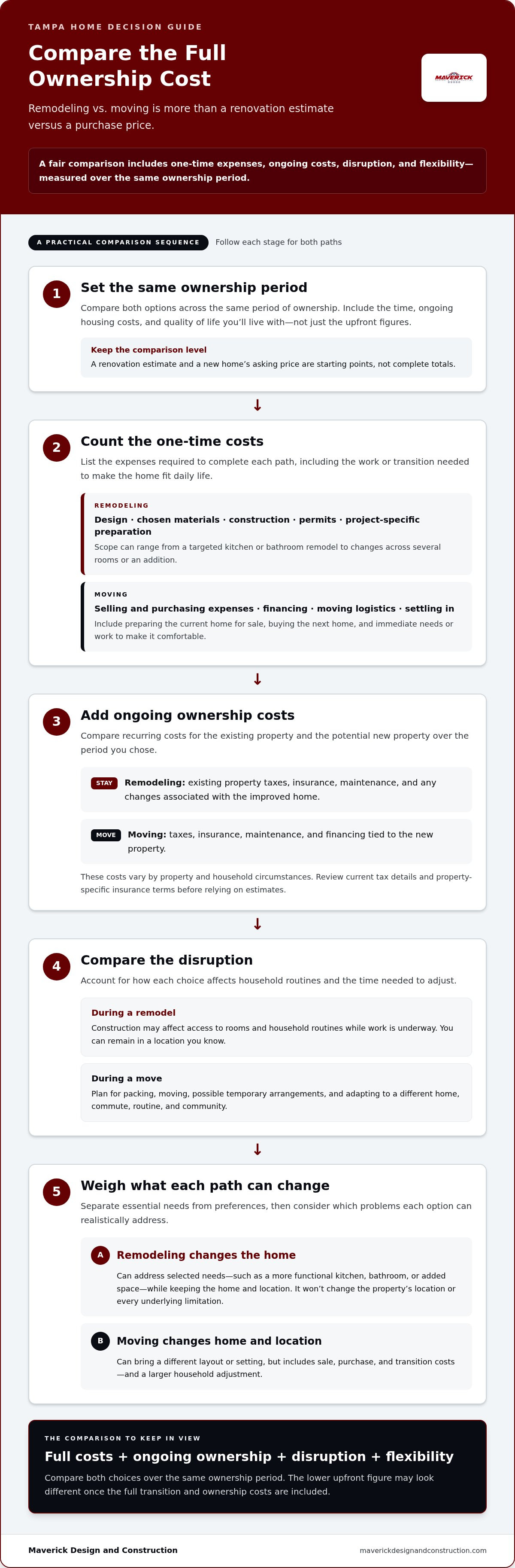
A renovation estimate and a new home’s asking price are only starting points. For a fair comparison of the cost of remodeling vs moving in Tampa, use the same ownership period for both options and account for cash outlays, recurring expenses, disruption, and flexibility. A lower upfront figure can look different once you include years of ownership costs and the time needed to complete the transition.
A fair comparison includes the full cost and the time horizon over which you’ll live with the decision. Use this framework to compare the options side by side:
| Factor | Remodeling | Moving |
|---|---|---|
| One-time costs | Design, chosen materials, construction, permits, and project-specific preparation. | Selling and purchasing expenses, financing costs, moving logistics, and settling into the new home. |
| Ongoing ownership | Existing property taxes, insurance, maintenance, and any changes associated with the improved home. | Taxes, insurance, maintenance, and financing tied to the new property. |
| Disruption | Construction activity may affect access to rooms and household routines during the work. | Packing, moving, transition arrangements, and adapting to a different home and location. |
| Flexibility | Can address selected needs while keeping the home and location. | Can change both the property and neighborhood, but involves a larger household transition. |
Which remodeling expenses should Tampa homeowners include?
Build your comparison around the work you actually need: design, selected materials, construction, permits, and site-specific preparation. Separate essential changes, such as improving a kitchen’s function or creating needed space, from optional finish upgrades. Existing conditions can sometimes reveal additional work once a project is underway. Base your plan on what’s known about the home, without assuming every renovation will uncover hidden issues.
Which moving and new-home expenses belong in the comparison?
Include costs involved in selling and buying, financing the next home, moving belongings, and making the new property ready for daily life. Compare ongoing property taxes, homeowners insurance, and maintenance for both homes. These costs can vary by property and household circumstances in Tampa. Review current tax details through relevant county offices and property-specific insurance terms before relying on estimates. Transaction costs also depend on the details of each sale and purchase.
Make time part of the calculation, too. A remodel may mean adapting routines around construction; a move may require temporary arrangements and an adjustment to a new location. If improving a suitable home remains a possibility, thoughtful remodeling planning can help clarify the scope you’re comparing.
Tampa Home and Location Factors That Can Change the Decision
The right choice depends on more than square footage. Your home’s condition, lot, neighborhood, routines, and future plans all shape the value of staying or moving. In Tampa Bay, property-specific factors such as flood exposure, wind resilience, and insurance also deserve attention. They can affect both the comfort of living in a home and the cost of owning it.
Separate problems a thoughtful design can address from limitations tied to the property itself. A cramped kitchen, insufficient storage, or a bathroom that no longer suits your household may be candidates for remodeling. A home addition may create needed space when the existing footprint falls short. Remodeling can’t change the street, commute, lot position, or nearby surroundings.
When does the existing Tampa home have strong reasons to stay?
Staying may make sense if you value your neighborhood, commute, schools, community connections, or a lot that suits your plans. If the setting works but the home’s layout doesn’t, improvements to the kitchen, bathroom, storage, or living space may bring daily life closer to what you need. An addition is worth considering when you need more room and the property can support an expansion.
Before comparing the cost of remodeling vs moving in Tampa, ask whether your dissatisfaction is about the house or the place it occupies. That distinction can prevent you from pursuing an interior solution to a location problem.
When might moving solve more than remodeling can?
Moving deserves consideration if the mismatch is persistent and beyond the home’s practical reach. The location may no longer suit your commute, the lot may not support the space you need, access may remain a concern, or structural limitations may make the desired changes impractical. Compare the lifestyle you want with what the property can realistically deliver. A new design can improve a home, but it can’t make every site suitable.
For Tampa Bay properties, review flood exposure and local property records for the specific address. FEMA’s Flood Map Service Center can help you review mapped flood information, but a map alone doesn’t show the full picture of a property’s condition or insurance terms. Review property-specific coverage details and consider wind resilience alongside the home’s condition and ownership costs.
Zoning, permits, and applicable Florida Building Code requirements can affect what changes are feasible. Verify current rules with relevant local authorities before making assumptions about an addition or major alteration. Precise, property-specific information makes the comparison stronger: a suitable location with a workable home may favor remodeling, while limits tied to the site or neighborhood may point toward a move.
A Five-Step Tampa Decision Framework for Remodeling or Moving
Make the choice in order rather than reacting to the first renovation estimate or appealing listing. A clear framework puts your household’s needs, the property’s limits, and the longer-term trade-offs on equal footing.
- 1. Define your needs. Write down what must change and what would simply be nice to have. A more functional cooking space, better storage, an accessible bathroom, or another living area may be essential; a particular finish may be a preference. This keeps either option from being judged against a moving target.
- 2. Assess the home and location. Consider the layout, condition, lot, and neighborhood together. Identify which limitations are inside the home and which are tied to its setting. If your commute or community is a reason to stay, give that real weight. If the location itself no longer fits, interior improvements won’t resolve the mismatch.
- 3. Scope the changes. List possible improvements by function, then consider how each relates to the existing layout and lot. Could a kitchen or bathroom redesign solve the everyday problem? Would custom storage help, or does your household need more living space? An addition may be worth exploring when the property can support expansion. A useful next read is Luxury Home Remodeling Sarasota: The 2026 Boutique Guide to High-End Renovation, which offers a remodeling perspective.
- 4. Model both paths. Compare the cost of remodeling vs moving in Tampa using current figures and the same assumptions for each option. Include ownership expenses, financing, maintenance, disruption, and the value of future flexibility. Use conservative estimates, allow for project-specific uncertainty, and don’t treat hoped-for resale value as guaranteed. If the current home can’t meet core needs, compare a fresh start through custom home building as well.
- 5. Choose a realistic horizon. Estimate how long you expect to stay, then compare both scenarios over that same period. A shorter stay may put more weight on upfront expenses; a longer one makes ongoing costs, daily comfort, and adaptability more important. Revisit the comparison if your plans or property assumptions change.
Once your priorities and project scope are clearer, explore thoughtful remodeling options for a home that still suits your location and long-term plans.
Make the Right Tampa Home Decision with a Thoughtful Project Plan
The right choice comes down to fit. If you value your neighborhood and the home can meet your needs, remodeling can preserve the location while improving how you live in it. If the mismatch goes beyond the rooms, lot, or practical scope of renovation, moving may offer a more complete reset. Neither option is automatically the better investment; the best answer reflects your priorities and plans.
What a well-planned renovation can change
Thoughtful design starts with how you use your home. A kitchen remodel can respond to the demands of cooking and gathering. A bathroom remodel can improve function and storage. A home addition may create more living space when the property can support an expansion. Premium materials and precise craftsmanship shape the finished space, while the project should address the needs you identified, not add upgrades for their own sake.
If the kitchen is your main concern, explore Maverick Design and Construction’s article on luxury kitchen remodeling for more inspiration. The same practical test applies to any renovation: will the proposed changes solve the everyday problem, and is the property a suitable fit for the work?
What to do next if a fresh start makes more sense
If the existing home can’t meet your core needs, even with a carefully considered remodel, custom home building may be worth considering. It gives you a chance to plan around your household’s priorities rather than adapt a property with limitations you can’t change. Keep the decision anchored in your preferred location, the property’s potential, and how long you expect your next home to serve you.
For the cost of remodeling vs moving in Tampa, clarity comes from comparing realistic options, not chasing a universal verdict. Maverick Design and Construction is a family-owned boutique builder that limits its annual projects to support personalized attention, premium materials, and American craftsmanship. That selective approach brings care to the planning as well as the finished work.
If remodeling fits your home and plans, or a custom home feels like the better direction, explore a project shaped around your priorities with Maverick Design and Construction. Start with what matters most: a more functional home, a better-fitting space, or a fresh beginning.
Choose the Home That Fits Your Next Chapter
The decision becomes clearer when you compare the full cost of remodeling vs moving in Tampa over a realistic ownership period, then weigh the numbers against the life you want to live. Remodeling can make a well-located home work better through considered kitchen, bathroom, or addition projects. Moving may be the stronger choice when the location or property itself no longer fits your needs.
Start with what matters most: the changes your household truly needs, the limitations you can’t change, and the costs and disruption each path brings. A thoughtful plan can help you move forward, whether that means improving a familiar home or building a fresh start.
Maverick Design and Construction is a family-owned boutique builder serving Tampa, St. Petersburg, Sarasota, and surrounding communities. By limiting annual projects, the team makes room for personalized attention and considered craftsmanship. Explore a thoughtful remodeling or custom-home project and take the next step toward a home that fits your plans.
Frequently Asked Questions
Is it cheaper to remodel or move in Tampa?
It depends on the renovation scope and the full costs of selling, buying, financing, and settling into another home. A focused project may cost less than a move, but extensive changes or unexpected work can alter the comparison. To assess the cost of remodeling vs moving in Tampa, compare both options over the same ownership period and include ongoing expenses, disruption, and how well each choice meets your needs.
How do I compare remodeling costs with the cost of moving?
Build two complete scenarios for the same period. For remodeling, include design, materials, construction, permits, and project-specific preparation. For moving, account for sale and purchase expenses, financing, moving logistics, and settling-in costs. Add ongoing property taxes, insurance, maintenance, and the practical impact of disruption. Use current figures for your circumstances and treat uncertain costs cautiously rather than relying on one upfront estimate.
Can remodeling increase my Tampa home's value?
Remodeling can improve function, comfort, and appeal, which may matter to future buyers, but no project guarantees a particular increase in value or a full return of its cost. The outcome depends on the home, project scope, workmanship, finishes, and market conditions when you sell. Consider resale alongside the daily benefit of a more useful kitchen, bathroom, storage area, or living space.
What Tampa-specific factors should I consider before remodeling or moving?
Look at the specific property, not just the neighborhood. Consider flood exposure, wind resilience, insurance terms, lot suitability, commute, and how well the location fits your household. If planning substantial changes, verify current zoning, permit, and Florida Building Code requirements with relevant local authorities. Review FEMA flood maps and local records for the property, and use current information when evaluating insurance rather than assuming nearby homes share the same conditions.
How long should I plan to stay for remodeling to make sense?
There’s no universal length of stay that makes a remodel worthwhile. The decision depends on how well the project addresses your needs, what it costs, and how long you expect to enjoy the improvements. Compare remodeling and moving over a realistic ownership horizon, including ongoing expenses and disruption. If you may leave soon, weigh the project’s immediate usefulness against its cost; if you plan to stay longer, consider comfort and changing household needs over time.
Should I remodel if my Tampa home has flood or insurance concerns?
Understand the property-specific concern before deciding on cosmetic or functional improvements. Review current flood information and local records, and examine the home’s insurance coverage and costs. A kitchen, bathroom, or addition project may improve daily living, but it won’t automatically resolve flood exposure or make insurance more affordable. Consider whether the underlying property risks fit your long-term plans before committing to broader renovations.
When is moving a better choice than remodeling?
Moving may be a better fit when the main problems involve location, lot limitations, access, or conditions a practical renovation can’t resolve. If your household’s essential needs require a different setting or a fundamentally different home, compare that fresh start with the realistic scope of remodeling. Custom home building may also be worth considering when an existing property can’t support your priorities. Base the decision on lifestyle, property suitability, and long-term plans.
Quick Links
Contact Us
Legal
© Maverick Design & Construction 2026 All Rights Reserved. Serving Tampa, South Tampa, Tampa Bay, and Sarasota County FL.