Maverick's Blog
High-End Residential Contractors in Tampa: What Sets the Right Partner Apart
What if the most impressive portfolio isn’t the clearest sign of the right builder? For homeowners comparing high end residential contractors Tampa has to offer, polished images matter, but so do the people, planning, and craftsmanship behind them.
It’s reasonable to want a home that reflects your vision and a project that receives careful, personal attention. In Tampa, thoughtful construction also means considering how heat, humidity, and coastal conditions may influence material and design decisions. A beautiful plan should work as well in daily life as it looks on paper.
This article explains what high-end residential contracting involves and how to assess an approach that connects design intent with practical execution. You’ll learn what to look for in communication, project involvement, craftsmanship, and local understanding, whether you’re planning a custom home, a luxury kitchen or bathroom remodel, or a home addition. The right partner offers clear guidance, careful work, and a genuine investment in your home.
Key Takeaways
- Understand how a high-end residential contractor guides a custom build or major renovation from design intent through construction.
- See how Tampa Bay property conditions, including heat, humidity, heavy rain, and storm exposure, can inform planning and material choices.
- Compare high end residential contractors Tampa homeowners may consider by looking beyond marketing claims to project attention, coordination, craftsmanship, communication, and local experience.
- Use a clear planning sequence to define your goals, assess your property, shape the scope, and align design with construction.
- Learn how a boutique builder’s focused project volume can support personalized attention and careful craftsmanship.
What a High-End Residential Contractor in Tampa Actually Does
A high-end residential contractor turns a homeowner’s plans and priorities into a carefully built home or renovation. The role reaches beyond the work on site: it brings design decisions, material choices, construction details, and project coordination together so each part supports the finished result. For homeowners comparing high end residential contractors Tampa, a key distinction is how well the partner carries the original intent through each stage.
A residential contractor connects the homeowner’s vision to the practical decisions and skilled work that bring it to life. That connection calls for steady coordination, close attention to detail, and considered choices before and during construction. As the construction industry encompasses many kinds of projects, homeowners benefit from a partner focused on residential spaces and the way people live in them.
Custom home construction and luxury remodeling are different project paths
A custom home begins with the owner’s vision and the property itself. The plan brings rooms, materials, and details together as a cohesive whole. A major renovation starts with an existing house: perhaps a kitchen that needs a new layout, a bathroom ready for a more considered design, or an addition that changes how the home functions. The right path depends on the home, site, and homeowner’s goals.
These project types raise different questions. A new build takes shape around the site and the life the owner wants to create. A renovation must also respond to the home’s existing structure and footprint. Clarifying the most important priorities helps define a scope that fits the project instead of forcing the home into a predetermined plan.
What homeowners should expect from a residential construction partner
Design intent should guide material selection and construction details, not stop at a set of drawings. A finish, fixture, or storage feature needs to work within the broader plan and be carried through carefully on site. Coordination continues throughout construction. Early decisions can affect later work, so the project partner needs to keep the moving parts aligned as the build progresses.
For a closer look at the custom-build process, explore this custom home builder in Tampa guide. It explains how a tailored approach can support a home shaped around its owner.
In practical terms, a strong partner connects decisions that might otherwise feel separate:
- Design and materials: Choose finishes and features that serve the intended look and function.
- Plans and site work: Keep the design in conversation with the property and existing home conditions.
- Craftsmanship and coordination: Carry details through construction with care and sequence the work thoughtfully.
That is what makes high-end residential construction more than a polished concept. It is the considered work of translating a vision into a home that feels cohesive, functions as intended, and reflects care in the details.
How Tampa Bay Conditions Shape High-End Residential Construction
A home’s setting is part of its design brief. In Tampa Bay, sun exposure, shade, drainage, existing structures, and distance from the coast can all influence planning and material choices. The right response depends on the property itself, not a broad assumption about every home in the region.
Local site context should shape residential design from the first decisions, because a home must suit its setting as carefully as it suits its owner. Consider how rooms connect to outdoor spaces, where rainwater flows, and which materials suit the home’s exposure. For high end residential contractors Tampa homeowners rely on, local understanding should show in practical planning, not just familiarity with place names.
Site and climate considerations across Tampa and the Suncoast
Heat and humidity can inform choices about finishes, ventilation, and connections between indoor and outdoor areas. Heavy rain makes drainage and the movement of water around the property important planning considerations. Storm exposure varies by site, so material and opening choices should reflect the property’s conditions rather than a one-size-fits-all assumption.
Orientation and shade affect how living spaces feel throughout the day. A homeowner planning a covered outdoor area, for example, may want to consider its placement alongside the sun’s path, access from the kitchen, and how the existing footprint supports the addition. In Tampa, St. Petersburg, or Sarasota, these questions are best answered by looking closely at the individual home and site. A coastal location may call for different considerations than a sheltered inland property.
Before settling on finishes or a layout, note where the property receives strong sun, where water collects after rain, and which existing rooms or outdoor areas you want to connect. These observations help turn preferences into useful design conversations.
Permitting and code considerations for Florida projects
Approvals and reviews depend on the project’s scope, the property’s location, and the rules that apply at the time. A new home, an addition, and a renovation can involve different considerations, while a property’s flood-zone status may also affect planning. As of October 2026, the Florida Building Code, 8th Edition (2023), governs construction in Tampa; the 9th Edition (2026) is scheduled to take effect on December 31, 2026. Assess each project under the requirements that apply at the time.
Local authorities oversee permitting and review according to jurisdiction and project details. Planning for these steps early helps keep design decisions aligned with required approvals. For more context on Florida-specific requirements, explore this Florida home-building regulations guide.
Thoughtful site planning brings beauty and practicality into the same conversation. If you’re considering a custom home or major renovation in Tampa Bay, explore Maverick Design and Construction’s residential building approach as you shape your project around its setting.
How to Compare High-End Residential Contractors in Tampa
A polished portfolio can show a builder’s taste, but it can’t tell you how carefully a project will be guided. When comparing high end residential contractors Tampa homeowners can work with, look beyond the images to the work behind them: personal attention, coordination, craftsmanship, communication, and understanding of local homes.
Use these criteria to compare how a residential construction partner approaches the work, not just how many services appear on a website. Each one affects whether your design stays coherent as decisions move from planning into construction.
| What to assess | Why it matters | What a thoughtful approach looks like |
|---|---|---|
| Project attention | Residential work involves decisions specific to your home and priorities. | Project involvement is deliberate, with your goals kept in view throughout the process. |
| Design coordination | Layout, finishes, materials, and construction details need to support one another. | Design choices are considered alongside how they’ll be carried out, rather than treated as separate conversations. |
| Craftsmanship | Fine details influence the finish and feel of a custom home or renovation. | Work reflects precision, careful material handling, and attention to how elements meet. |
| Communication | Projects involve ongoing decisions and coordination. | Responsibilities and decisions are discussed clearly as the work advances. |
| Local experience | Homes and sites have distinct conditions that can inform project planning. | Planning takes the specific property and its context into account. |
Look for a process that connects design and execution
Strong coordination starts before construction details are finalized. A kitchen’s layout can affect cabinetry, storage, lighting, and surface choices. In a custom home, design decisions influence how rooms and materials come together. Keeping these choices connected helps preserve the intent of the design as the project takes shape.
Clear responsibilities and consistent communication matter just as much. You should understand how decisions are handled and how project updates are shared. The details and timing vary by project, but coordination should continue throughout the work, not wait until the final stage.
Assess craftsmanship and personal attention together
Craftsmanship is visible in precise fit, considered transitions, and care for chosen materials. Personal attention helps protect those details by keeping the project’s priorities in focus. Maverick Design and Construction limits annual project volume to support personalized attention, premium materials, and American craftsmanship. A boutique firm’s intentionally limited workload is a deliberate model for focused service, not simply a question of size.
When assessing craftsmanship, look closely at how finishes meet, how materials are handled, and whether details support the overall design. Together, these criteria offer a more useful comparison than broad promises: they help you judge how well a partner’s approach fits the home you want to build or improve.
Match Your Tampa Residential Project to the Right Construction Approach
A clear project brief doesn’t need to begin with a finished design. Start with what you want your home to do better, then let the property and your priorities shape the scope. This gives high end residential contractors Tampa homeowners work with a practical foundation for connecting design decisions to construction planning.
Start with the outcome, property, and scope
Before choosing finishes, describe what you hope will feel or function differently when the work is complete. Is the priority a home designed around your needs, a kitchen that better supports everyday routines, a more considered bathroom, or additional space for changing household needs? Separate essential functional goals from preferred finishes and ideas you may want to explore later. That distinction helps keep the project focused while leaving room for thoughtful design.
Then consider the property. A new home begins with a site and a vision; a renovation must respond to an existing layout and conditions. An addition has to relate to the current home and the way you use it. The right approach follows from both the desired outcome and what the property can support.
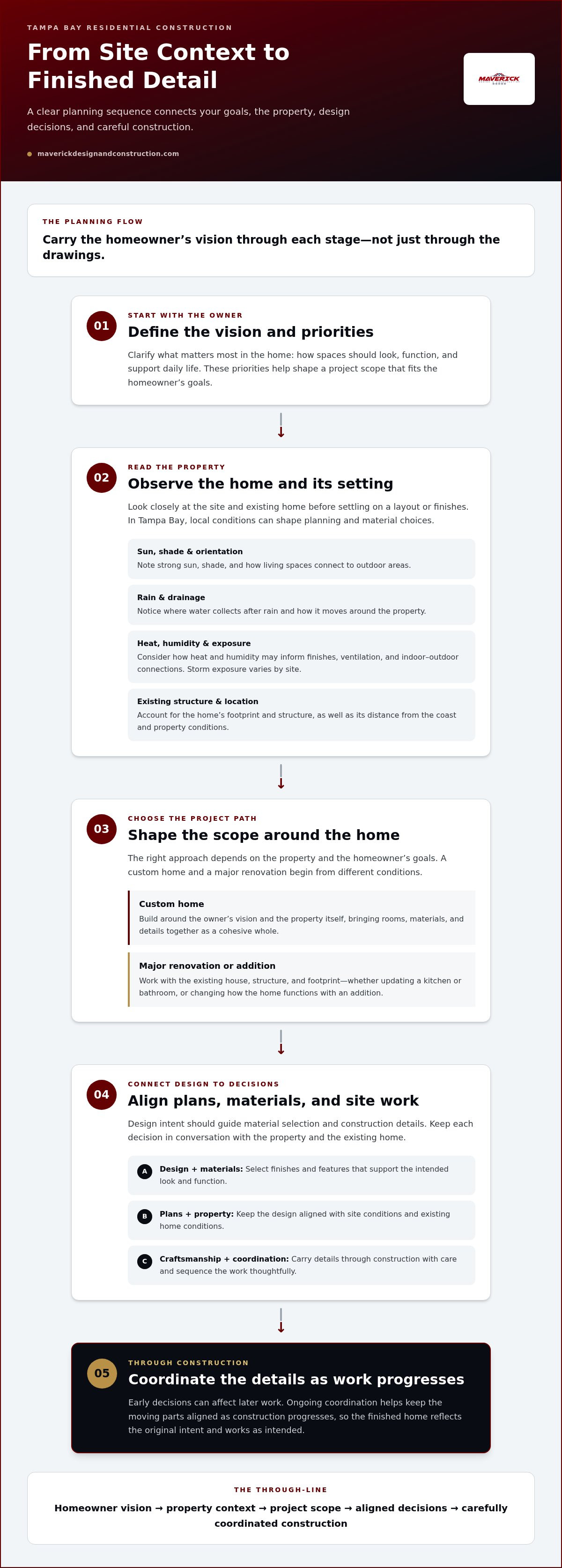
Use this four-step sequence to turn an initial idea into a workable direction:
- Define your goals. Write down what you want to change and why. Note the needs that matter most, such as more useful storage, a different kitchen layout, or space for a growing household.
- Assess the property. Consider the home’s existing rooms, footprint, and relationship to its site. For a new build, focus on how your priorities can respond to the property; for a renovation, identify what you want to retain, improve, or rethink.
- Shape the scope. Decide whether your primary project is a custom home, kitchen remodel, bathroom remodel, or addition. Keep essential work distinct from optional enhancements so the project has a clear center.
- Align design and construction. Bring layout, materials, finishes, and practical execution into one conversation. The scope should reflect both the home’s conditions and your priorities.
Bring design intent and construction planning together
These steps are connected. A layout affects how a space functions; material selections influence the character of the finished room; construction planning determines how those choices are carried through the work. Treating them as separate decisions can make it harder to preserve a consistent vision. A considered scope keeps the intended look and daily use in view together.
For a renovation, the existing home helps determine what makes sense. Tailor the project to its conditions rather than relying on assumptions about what every home needs. If you’re weighing a kitchen, bathroom, or broader update, consider how the design, materials, and construction details can work together to suit the home and its owners.
With your goals and scope taking shape, explore a residential construction partner for your Tampa-area project and bring your priorities into the planning conversation.
Maverick Design and Construction: A Boutique Tampa-Area Partner
Choosing among high end residential contractors Tampa homeowners can work with means finding a partner whose approach fits the home and the people who live in it. Maverick Design and Construction is a family-owned boutique builder serving Tampa, St. Petersburg, Sarasota, and surrounding Suncoast communities. The work is personal by design: each project begins with the homeowner’s priorities and the property’s context.
Whether you’re planning a custom home or reimagining an existing one, design choices and construction details need to move together. Maverick builds custom homes and completes high-end kitchen and bathroom remodels and home additions. Each project has its own purpose, setting, and decisions. The aim is to shape the work around those specifics, with care for the materials, the craftsmanship, and the finished home.
Personal attention, careful craftsmanship, and local roots
As a family-owned boutique firm, Maverick limits its annual project volume to support personalized attention and close project involvement. That deliberate focus brings planning together with construction, premium materials, and American craftsmanship. Rather than treating a home as one more item on a broad schedule, the team keeps the homeowner’s priorities at the center of the work.
Craftsmanship develops through decisions made throughout a project: selecting materials suited to the design, carrying details carefully into construction, and taking care with the finished work. Local roots also mean approaching each property on its own terms. A home in Tampa, St. Petersburg, or Sarasota has its own setting and considerations, so the project conversation starts with the actual home, not a generic template.
Take the next step with a Tampa-area residential project
A useful first conversation starts with what you want to build or change. You might be considering a custom home, a kitchen or bathroom renovation, or an addition that gives your household more room. Sharing your goals, the property context, and the outcome you hope for helps define an approach that reflects your priorities.
From there, shape the scope around the home and the work ahead. Design intent, material choices, and construction planning belong in the same conversation so the details support a cohesive result. The approach should fit your project, not the other way around.
If you’re ready to discuss a custom build or major renovation in the Tampa area, discuss your residential project with Maverick Design and Construction. Begin with your goals, your property, and the home you envision.
Shape the Next Chapter of Your Home
The right construction partnership should make the path ahead feel clearer. As you consider high end residential contractors Tampa homeowners can work with, focus on the fit between your vision, the property, and the people guiding the work. Your first step doesn’t need to be a complete set of plans. A clear sense of what you want your home to become is enough to begin a useful conversation.
Maverick Design and Construction is a family-owned boutique firm that intentionally limits its annual project volume, creating room for personalized attention and careful craftsmanship. Whether your plans involve a custom home, a kitchen or bathroom renovation, or an addition, the project should be shaped around your priorities and the character of your home. That thoughtful approach serves homeowners in Tampa, St. Petersburg, Sarasota, and surrounding Suncoast communities.
Bring your ideas, questions, and hopes for the finished space. Discuss your Tampa-area residential project with Maverick and take the first step toward a home that feels distinctly yours.
Frequently Asked Questions
How long does a high-end residential construction project in Tampa take?
There isn’t one reliable timeline for every project. Duration depends on the scope, design development, site conditions, material selections, approvals, and construction complexity. A custom home follows a different path from a focused renovation, such as updating a bathroom while keeping the rest of the home untouched. Early planning can clarify which decisions and review stages shape the schedule, but a project-specific timeline requires a defined scope and a closer understanding of the property.
Does a Tampa home need different planning because of heat, humidity, or storms?
It may, depending on the home’s location and exposure. Sun, humidity, heavy rain, and storm conditions can inform material selection, drainage planning, and connections between outdoor spaces and the home. For example, shade and the direction of afternoon sun may influence where you place a covered seating area. Planning should account for the specific property and applicable current code requirements rather than rely on blanket assumptions.
Can I live in my home during a luxury renovation?
Sometimes, but it depends on which rooms are affected, how the work is sequenced, and what your household needs each day. A kitchen renovation may disrupt meal preparation, while a bathroom project can affect access to essential facilities. Before construction planning is finalized, consider household routines, pets, children, and any work-from-home needs. The scope and site arrangements can then account for those needs, though occupancy throughout a project can’t be assumed.
What is the difference between a residential contractor and a design-build firm?
A residential contractor focuses on managing construction work; a design-build approach coordinates design and construction within one project process. Industry usage can vary, so the label alone may not tell you how responsibilities are divided. When comparing high end residential contractors Tampa offers, understand who develops the design, who coordinates construction details, and how decisions are carried from plans into the finished home.
Do home additions in Tampa require permits?
Often, yes, but the permits and reviews for a Tampa-area addition depend on the work, property location, and current local requirements. An addition can involve more review than a cosmetic change because it alters the home’s footprint. Planning should account for applicable permitting and code considerations before construction decisions are set. Requirements depend on the property’s jurisdiction, so don’t assume one process applies throughout the region.
What should I prepare before discussing a custom home or renovation?
Bring any available property plans, measurements, or photographs, along with a short list of what matters most in the finished home. You might note storage needs, entertaining habits, accessibility preferences, or rooms that feel underused. Images of details you like can help explain your taste, even if you haven’t selected specific finishes. You don’t need a complete design; a few clear references and practical observations can make the first project conversation more productive.
Quick Links
Contact Us
Legal
© Maverick Design & Construction 2026 All Rights Reserved. Serving Tampa, South Tampa, Tampa Bay, and Sarasota County FL.